

In the Energy Industry, conversations on energy access often stop at megawatts, numbers of connections, or financing volumes. Yet the lasting success of large-scale energy programmes depends on an invisible but decisive architecture: environmental and social safeguards.
Under the Rural Electrification Agency’s Nigeria Electrification Programme (REA-NEP), this architecture is the very mechanism that secures the programme’s social licence to operate, de-risks investment, and turns power into durable development, not an optional compliance add-on
Environmental, social, and governance (ESG), are criteria, which refer to the measurements and exposure concerning the integration of environmental and social sustainability and ethics into the operations and decisions of organizations.
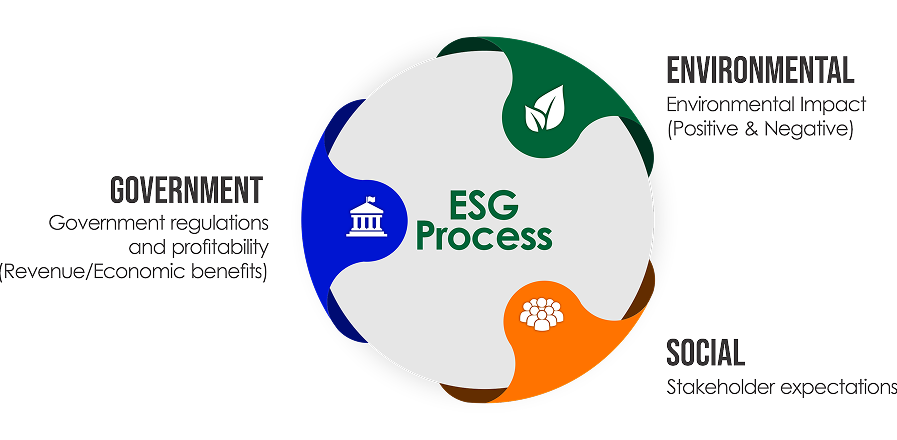
Understanding the Safeguards Design
ESG considerations have become integral to sustainable project management, reshaping the way businesses operate in the modern economy. The Rural Electrification Agency (REA), a frontrunner in Nigeria’s renewable energy transition, demonstrates a compelling case for ESG assessments contributing to sustainable development through the Nigeria Electrification Programme (NEP).
The implementation of ESG is not only based on environmental savings and social alleviation, but rather, it also brings economic value (see Fig 1), reduces pollution, resource depletion, and climate change, which are environmental issues that harm stakeholders like local communities and ecosystems.
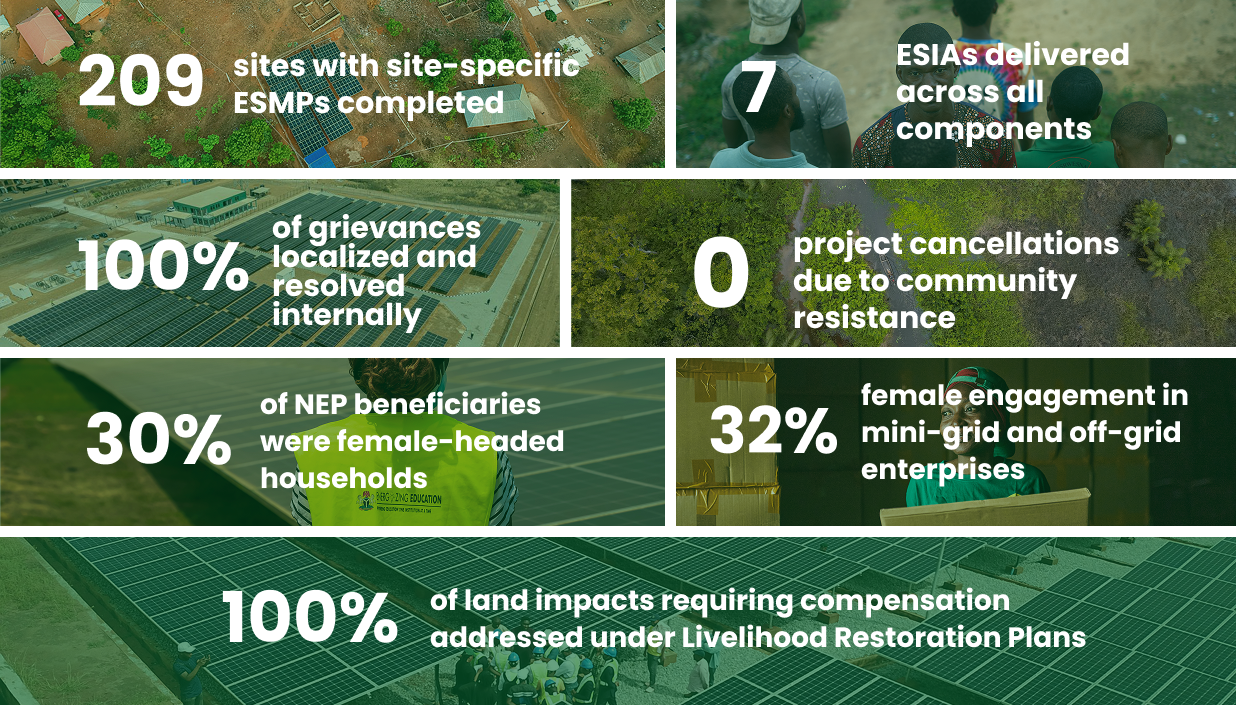
Evidence of Impact Under the NEP
DARES is not starting from theory, it is scaling what already works.
Under the NEP
DARES drives at scale. As Nigeria moves from pilot proof-of-concepts to continent-leading rollouts, the technical challenge is matched, and in many cases exceeded, by social and environmental complexity. Unmanaged, these complexities create project delays, community resistance, reputational risk, and fiscal waste. Properly managed, they become value levers: improved community buy-in, smoother permitting, investment readiness, and sustainable socio-economic outcomes. The DARES Environmental and Social Management Framework (ESMF) explicitly reframes safeguards in this strategic light.
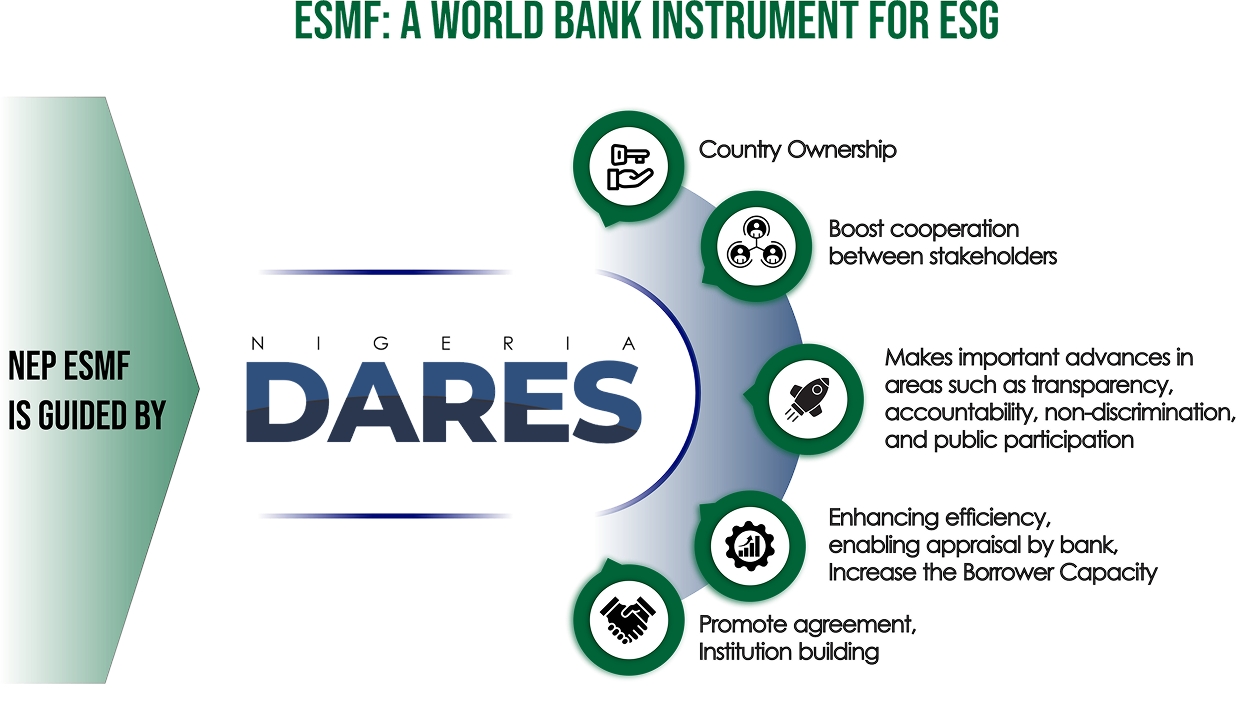
The institutional instruments: ESMF, ESMS and the World Bank ESS
DARES mainstreams safeguards practice through three complementary instruments. The ESMF establishes the programme-level standards and screening logic; site-level Environmental and Social Impact Assessments (ESIA), Environmental and Social Management Plans (ESMP), Stakeholders engagement plan and provide location-specific grievance mitigation; and each developer must submit an Environmental and Social Management System (ESMS) that operationalizes those commitments in their business model.
This structure aligns national laws (notably the EIA Act) with the World Bank’s Environmental and Social Standards (ESS 1–10), ensuring both legal conformity and investor confidence.
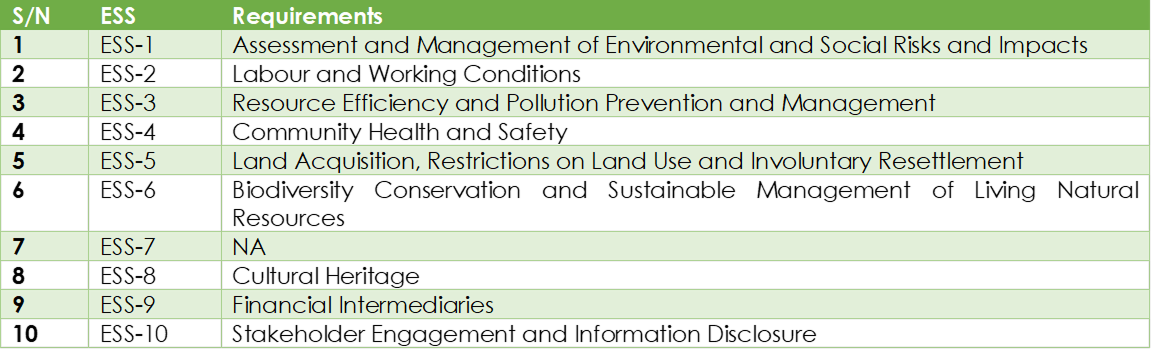
Operationalizing these instruments requires more than paperwork. The ESMS is governed by six principles; systematic risk management, resourcing, transparent reporting, safety-first operations, human-rights respect, and climate mainstreaming, which together create an enforceable practice rather than a checklist.
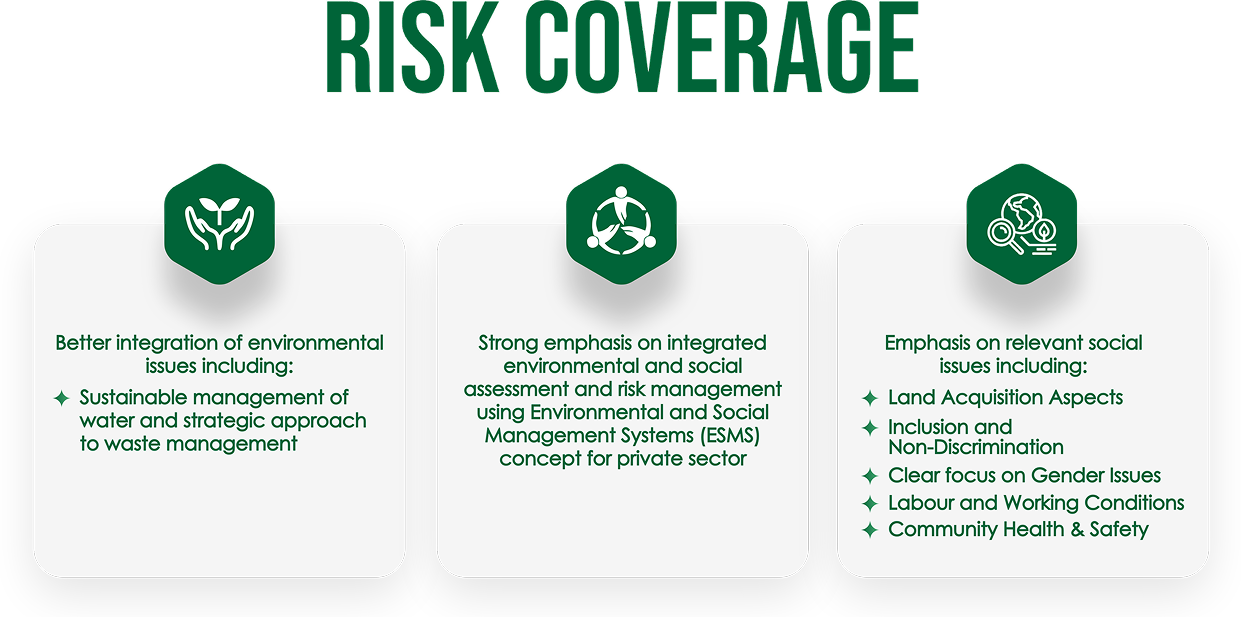
The Risk Landscape: What Nigeria DARES Is Designed to Prevent and Manage
Nigeria DARES operates across a deliberately diverse portfolio; mini grids, standalone solar systems, public institution electrification, spanning Nigeria’s varied ecological zones and social contexts.
This diversity creates complexity, but it is complexity that has been anticipated and structurally managed within the NEP framework.
The principal risks are not theoretical; they are well documented in off grid energy markets globally. What distinguishes Nigeria DARES is not the absence of risk, but the intentional design put in place to mitigate, monitor, and enforce safeguards at scale. They include:
Land acquisition and livelihood impacts: Even small scale energy infrastructure can disrupt livelihoods if land access is poorly handled. Under DARES, land related risks are addressed through early screening, transparent consultations, and the preparation of Livelihood Restoration Plans (LRPs) where required. Compensation processes are guided by World Bank ESS 5 and national law, ensuring that communities are not economically worse off as a result of electrification.
Community health, safety, and gender-based violence (GBV): Construction activities and labour influx can heighten social risks if unmanaged. NEP addresses this through mandatory site level risk assessments, GBV Action Plans, Codes of Conduct for contractors, and accessible grievance redress mechanisms (GRMs). These are not optional safeguards but conditions tied to project approval and continued participation, reinforced through independent verification and monitoring.
Occupational health, safety, and labour standards: DARES embeds ESS 2 compliance through enforceable Occupational Health and Safety (OHS) standards, contractor training requirements, and incident reporting protocols. Developers must demonstrate capacity to manage labour risks before financial close, reinforcing a culture of prevention rather than remediation.
Biodiversity action plans and ecosystem impacts: Projects located near sensitive ecosystems, such as wetlands or mangrove zones, require heightened scrutiny. NEP’s safeguard screening explicitly flags high risk sites, triggering enhanced ESIA requirements, adaptive mitigation measures, and ongoing environmental monitoring. This ensures that renewable energy deployment aligns with biodiversity protection rather than undermining it.
Across all these risk categories, the critical point is enforcement. Safeguards under REA-NEP are not static documents but living obligations, linked to results based disbursement, periodic audits, and corrective action plans. Mitigation is financed, supervised, and verified, ensuring that safeguards keep pace with scale.
Conclusion
Nigeria DARES is a test of whether Africa can scale clean energy at pace without sacrificing social and environmental integrity.
The environmental and social safeguards articulated in the ESMF and implemented through firm ESMS obligations are the programme’s hidden backbone, they secure consent, reduce risk, and convert electrification into enduring development. To fail at safeguards would be to forfeit the social licence and, with it, investment, impact, and legitimacy. To succeed is to demonstrate a new model: one in which large scale electrification proceeds at speed precisely because it has been designed to protect people and ecosystems from the outset.
We must champion safeguards as the strategic architecture that enables scalability, resilience, and equitable prosperity. The Nigeria DARES project, being executed with rigorous E&S practice, is that demonstration. And critically, it aligns with Nigeria’s commitments under Mission 300, where the pledge is not only to increase the energy access growth rate by 9% annually between 2024 and 2030, but to do so in a way that is inclusive, just, and sustainable. Safeguards, therefore, ensure that the Mission 300 promise translates into real impact for people, communities, and ecosystems.
Related Articles
Loading comments…